Robert did not begin as a finished plan.

It began with a simple idea: a different way to build movement.

What followed was a process of discovery - where each small experiment led to the next, eventually forming a humanoid LEGO® robot designed for expression, interaction, and future buildability.

How it started

Robert began with a simple observation.

While working on small LEGO® Technic motorcycles created in support of Bikers Against Child Abuse (BACA), I used flexible axle connectors as part of the suspension system.

Those motorcycles had their own story. I originally tried to offer the designs directly to LEGO with the idea that they could support BACA through a small share of the profit. It was meant to be a quiet gesture, but I was advised that the only path forward was to submit them through LEGO Ideas. I followed that route with the intention of donating any potential reward, although the project never gained traction there.

Even though that path did not lead where I expected, it led to something else entirely.

I started wondering whether the same flexible axle connectors could be used as joints for fingers. After experimenting with a single finger, it became clear that the idea could be taken much further.

What began as a small mechanical concept quickly became too interesting to ignore. Even though I was already working on another large project, I kept following the idea step by step.

In that sense, Robert was not planned in the usual way - he was discovered.
Learn more about BACA →

The idea behind the journey

Robert is not an isolated invention. He is part of a longer process of exploring how simple ideas can grow into more complex and functional systems through patience, iteration, and design.

That process is visible in the posts below. They show the project evolving from an early tendon-driven concept into something that did not fit into any existing category.

But just as importantly, they reflect something else: this was never only about making something impressive. It was about making something understandable, meaningful, and eventually shareable.

What followed was a series of small steps, each one building on the last.

The journey in public

The development of Robert was documented step by step through posts shared online. What started as a small experimental mechanism gradually became a complete humanoid system.

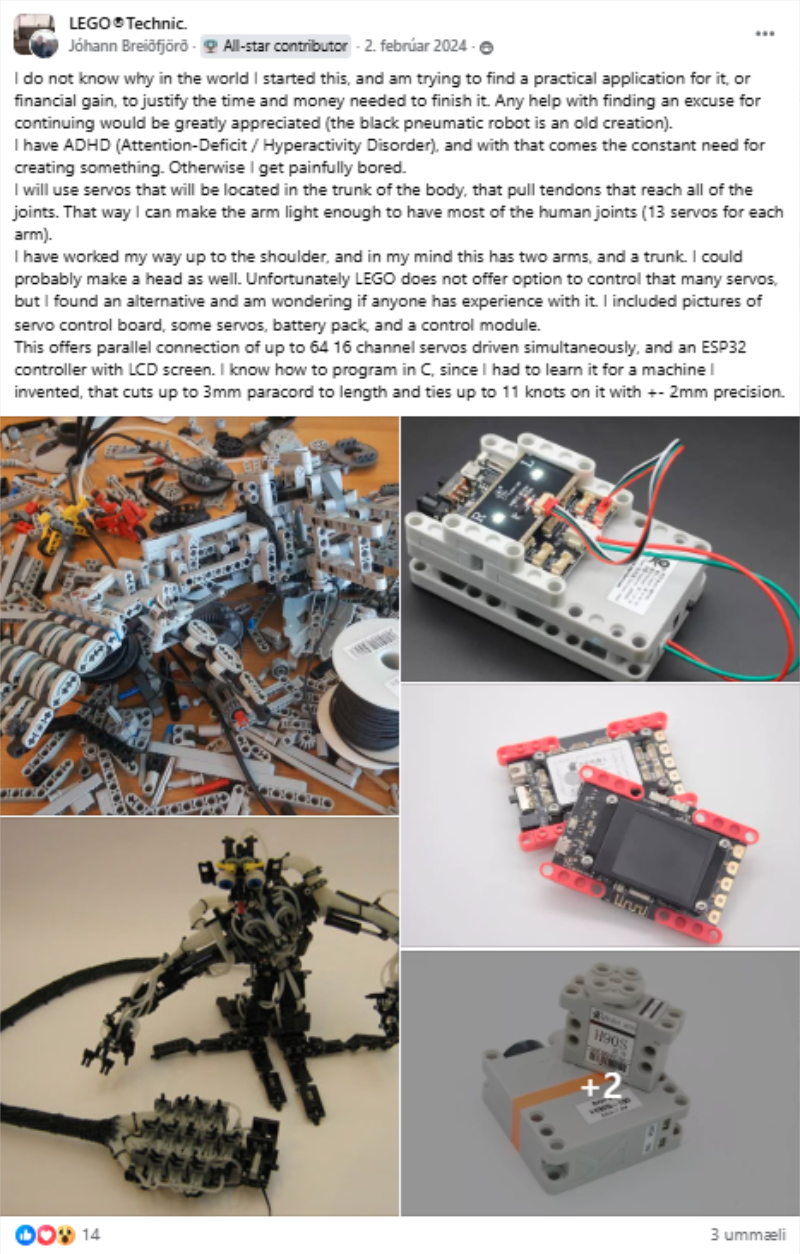
2 February 2024

First concept

The core idea was already there: place the servos in the body, use tendons to reach the joints, and keep the arm structure light enough to make a more human-like range of motion possible.

Facebook post from 2 February 2024 showing early tendon-driven LEGO robot concepts and electronics.
6 February 2024

Shoulder breakthrough

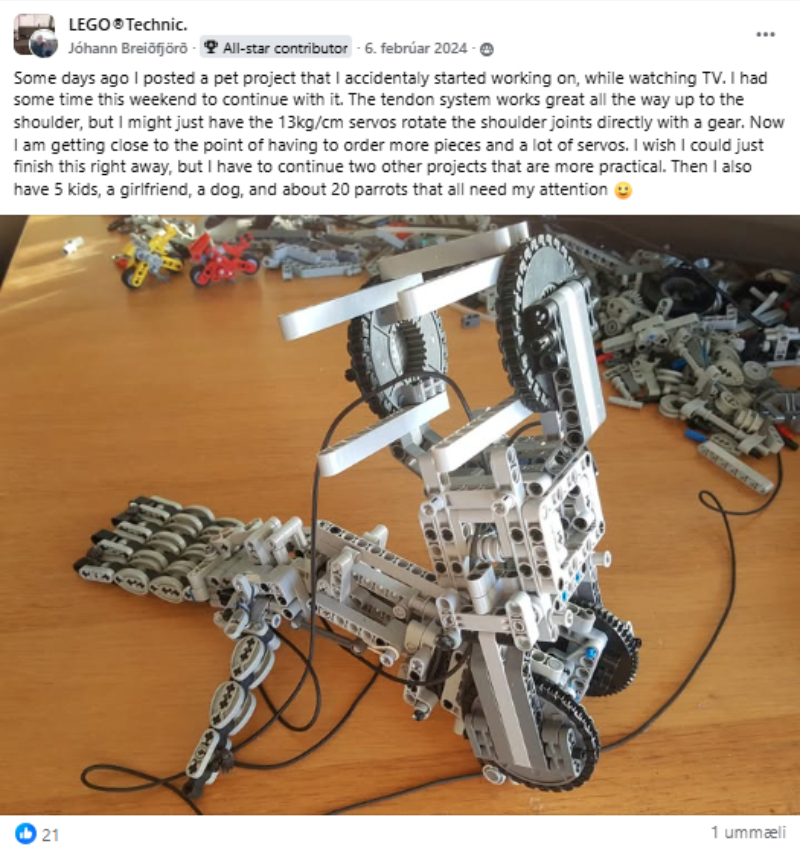
The tendon system was already working all the way up to the shoulder. This was an important proof that the concept could scale beyond a single finger or hand and begin becoming something larger.

Facebook post from 6 February 2024 showing an early tendon-driven shoulder and hand prototype.
1 March 2024

Structure begins to emerge

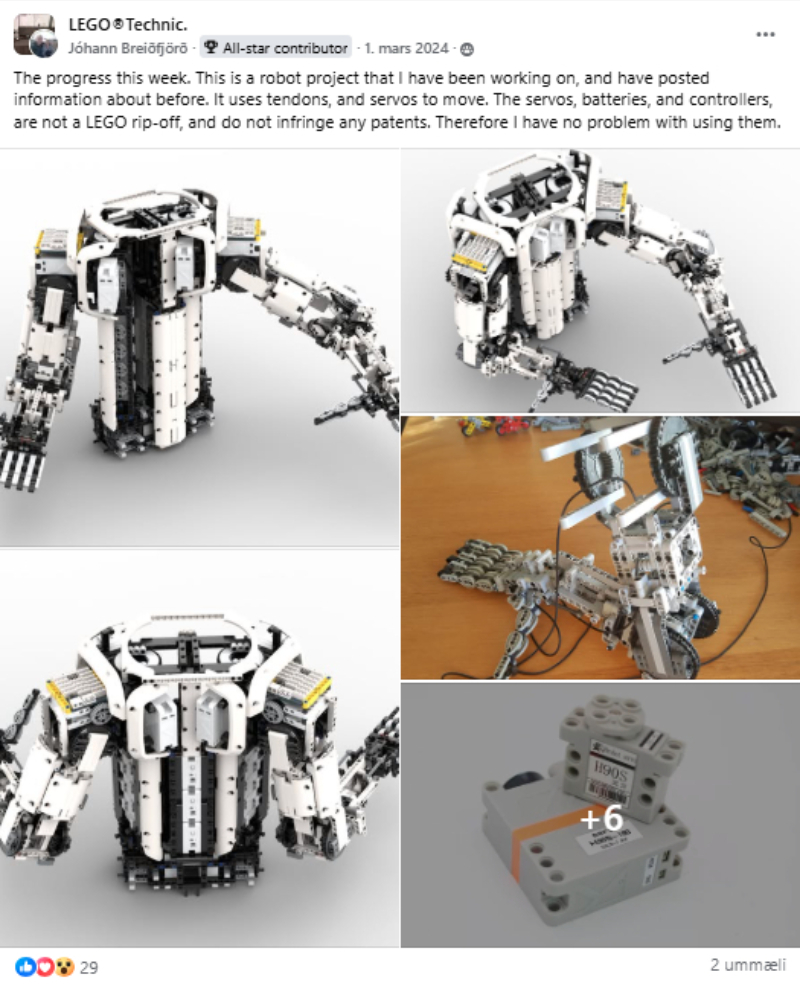
The project was starting to evolve from an isolated mechanism into a real upper-body concept. More of Robert’s structure was taking shape, and the direction was becoming clearer.

Facebook post from 1 March 2024 showing early torso and arm structure for Robert.
8 March 2024

A complete system starts to form

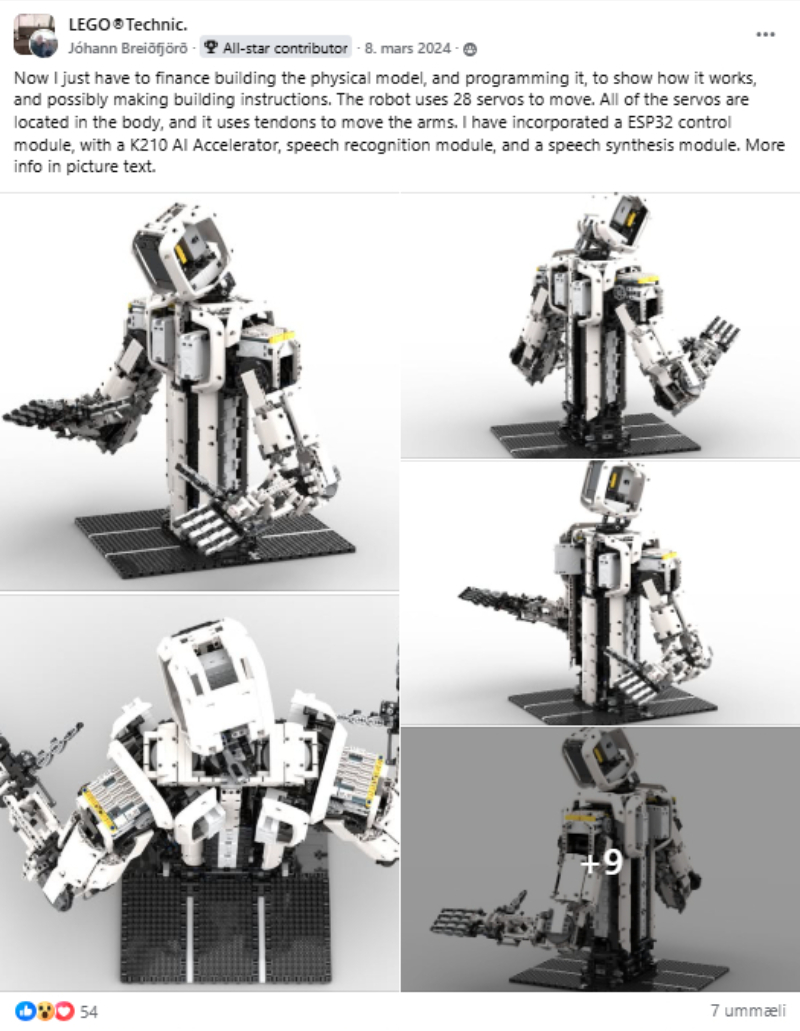
By this point, Robert had become much more than an experiment. The number of servos, the control approach, and the direction toward future instructions were all becoming part of a coherent system.

Facebook post from 8 March 2024 showing a more developed Robert with structured upper body and arm positions.
24 March 2024

External support arrives

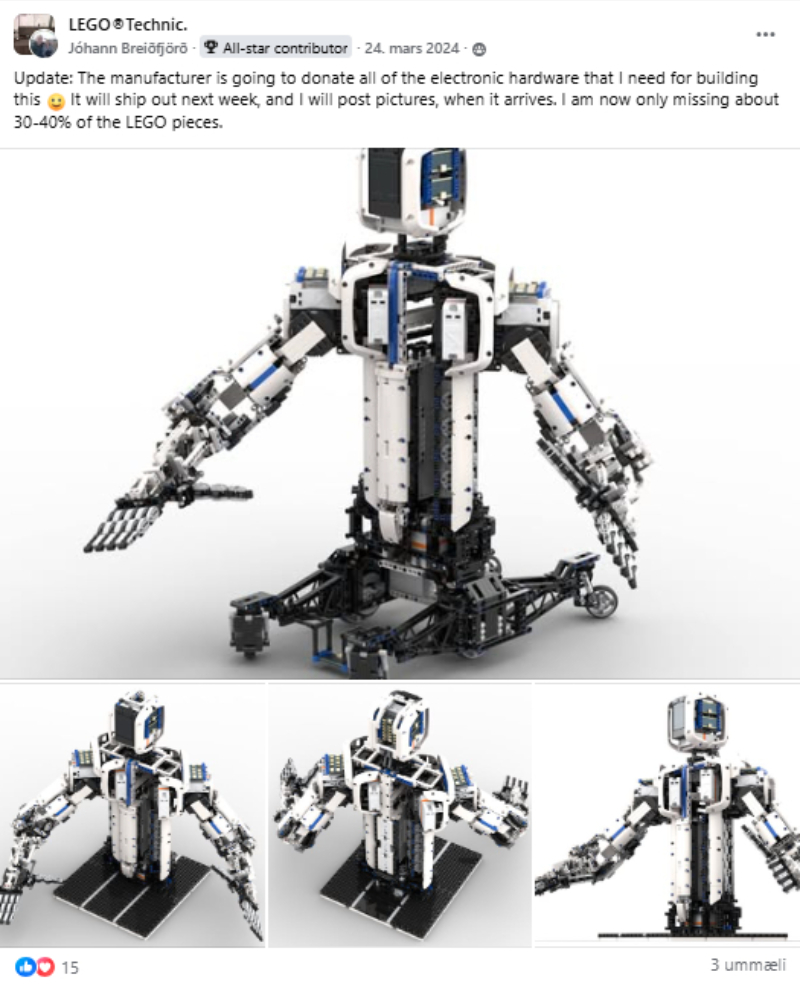
A major milestone: the manufacturer of the electronic hardware donated what was needed to continue building the system. This was one of the first strong signals that others could also see the potential in the project.

Facebook post from 24 March 2024 showing Robert in a more complete upper-body configuration.

Around this stage, others began to see it as something real.

Others started to see the potential

Around this early stage, the hardware manufacturer created a video based on renderings and design material I had shared.

Seeing the project presented in this way was one of the first moments where it felt real beyond my own work. It marked a shift from something I was building to something that could be understood and experienced by others.

15 May 2024

Robert takes shape

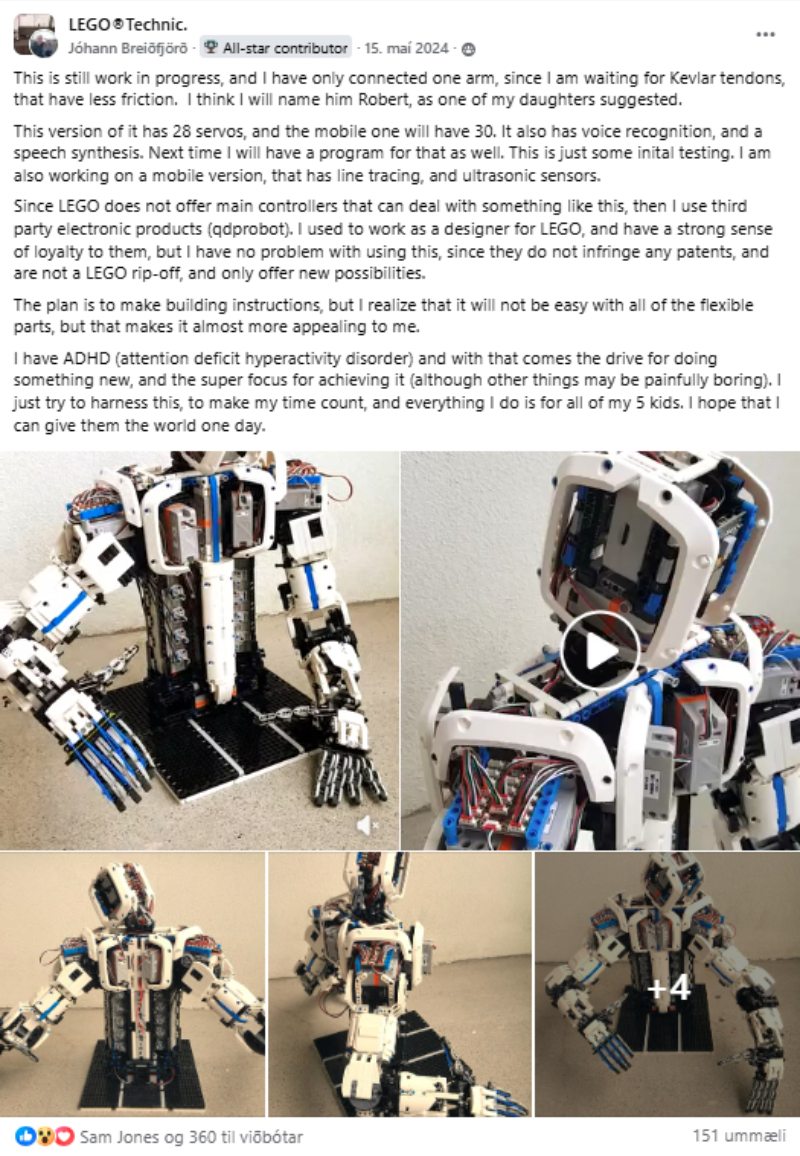
Robert had now become recognizable not only as a mechanism, but as a character and a system. More hardware was integrated, movement had expanded, and the project was gaining identity.

Facebook post from 15 May 2024 showing Robert in a much more developed physical form.
30 May 2024

A major interaction milestone

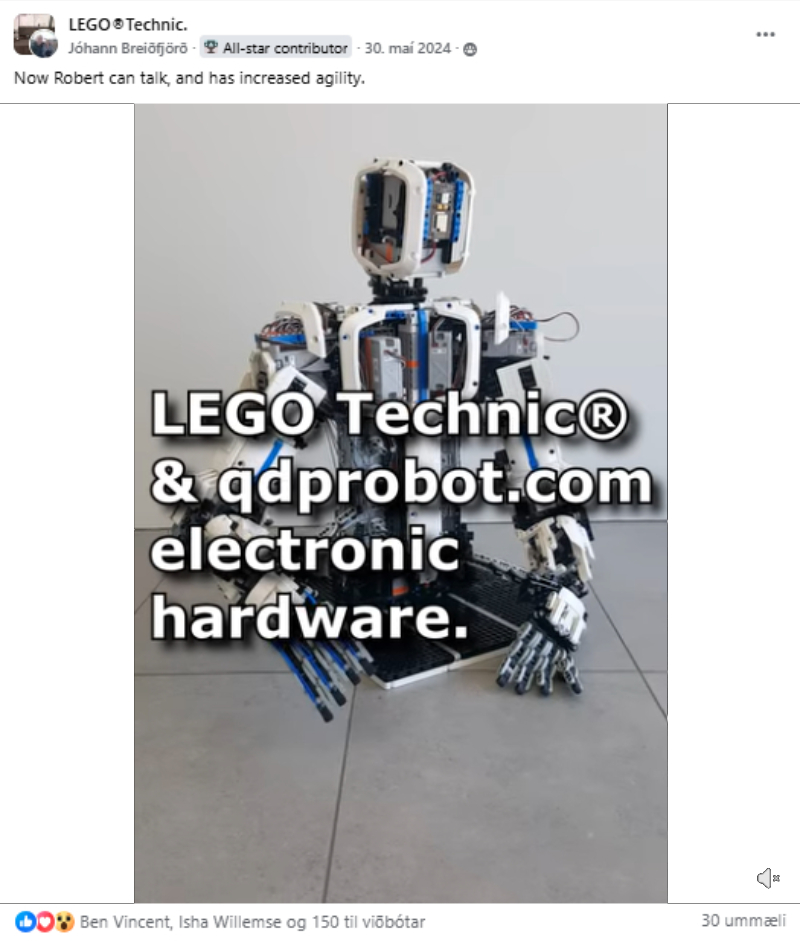
Robert could now talk and had increased agility. This was a key transition point: the project was no longer only mechanical. It was becoming expressive and interactive.

Facebook post from 30 May 2024 showing Robert standing more fully developed with increased agility.
14 April 2025

Function grows beyond motion

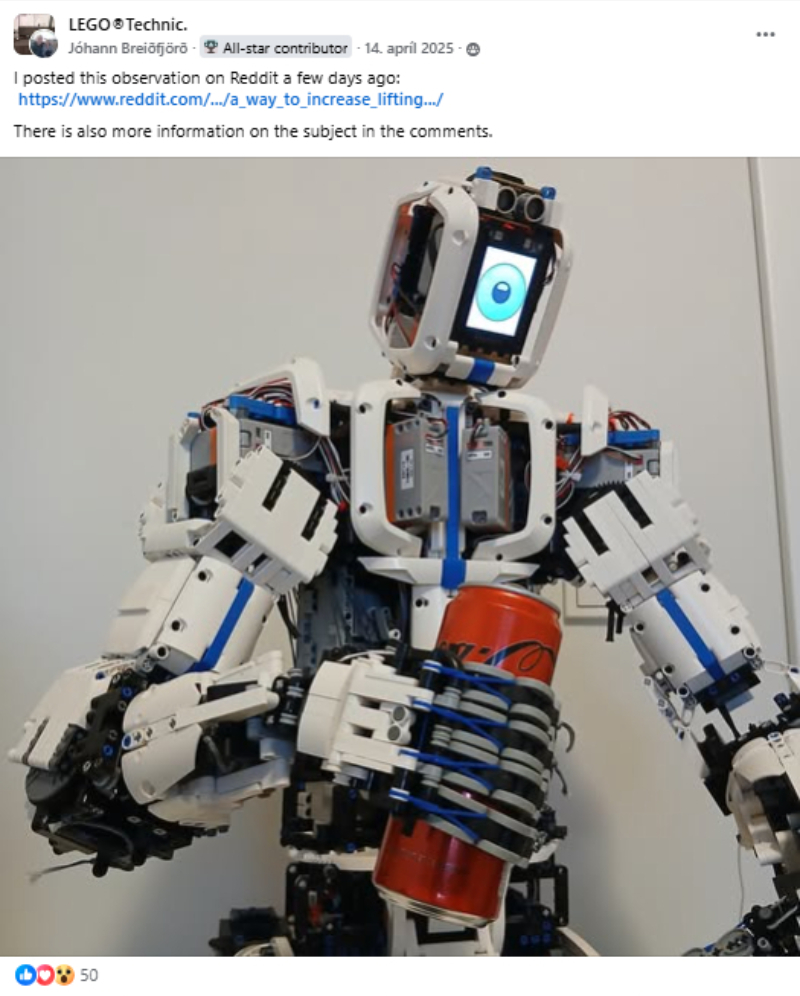
Over time, Robert’s development moved further beyond movement alone. The system kept evolving toward more practical interaction, greater refinement, and more advanced behavior.

Facebook post from 14 April 2025 showing Robert holding a cup and demonstrating more advanced capability.
25 August 2025

Expression and interaction mature

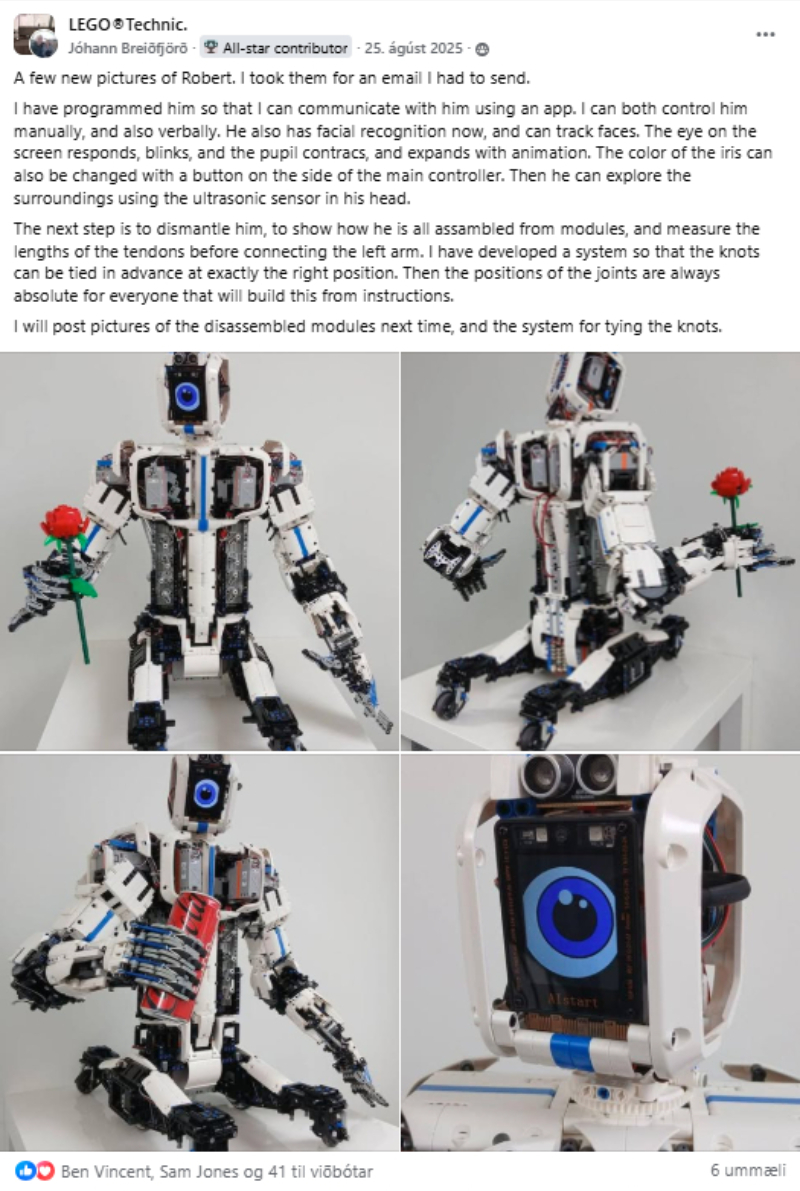
By this stage, Robert had evolved into a much more expressive and capable system, with visual expression, communication, and more advanced interaction built into the experience.

Facebook post from 25 August 2025 showing Robert with expressive eye display and a flower.

By this point, Robert was no longer just a concept. He had become a complete and expressive system.

Moments along the way

Not every moment in Robert’s development was technical. Some of the most memorable ones were simply part of everyday life around the project.

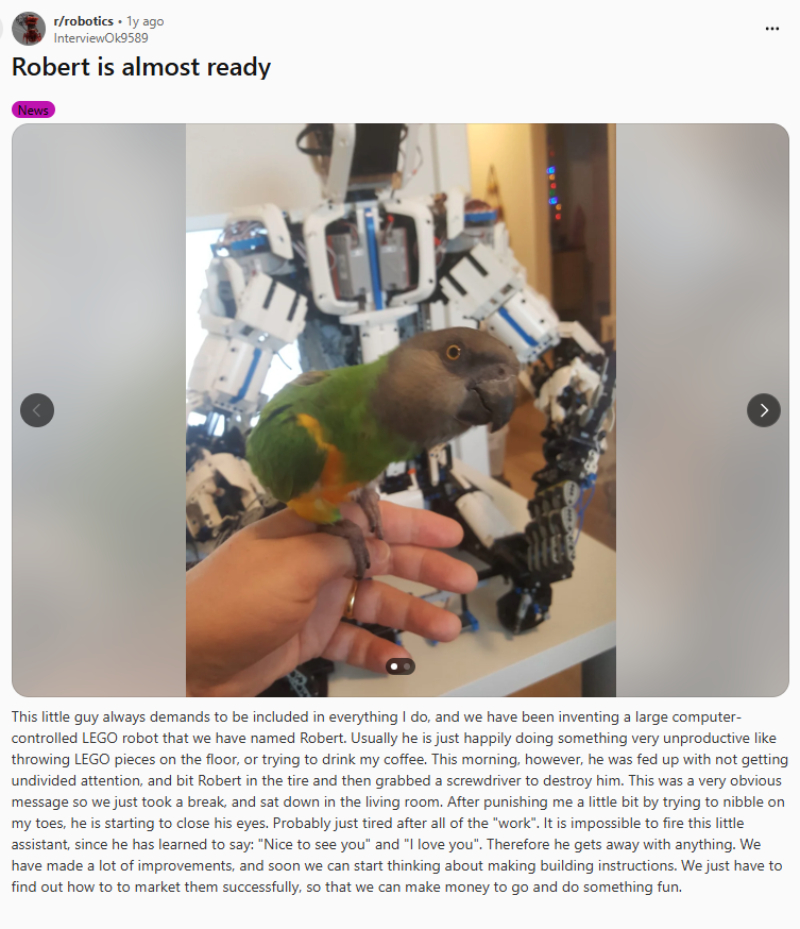
Robert is almost ready

This Reddit post adds a more personal and playful side to the story. It is not part of the main technical timeline, but it helps show the real world around the project - and the life that existed around Robert as he developed.

Link to post on Reddit →
Reddit post showing Robert in the background and a parrot in the foreground.

What started as a small mechanical idea had become something much more complete.

Where Robert is now

Robert is far more refined today than in these early stages of development. Movement is smoother, the structure is stronger, friction has been reduced, and the system has evolved significantly in both interaction and expression.

What began as an experiment has become a complete and evolving platform - one that combines mechanical design, electronics, and software into a unified system.

But the goal has never been just to build something impressive. The aim is to make Robert understandable and buildable for others - through clear instructions, modular design, and a system that can be explored, modified, and expanded.

This is not the end of the project, but a transition point.

The next step is to make Robert something others can build - and continue evolving beyond this point.